Teaching Money Skills In Special Education
Mastering money skills empowers students to navigate daily life with confidence.
Teaching Real-World Money Skills in a High School Special Education Classroom
Introduction:
Teaching money skills is a crucial part of preparing students in special education for independent living and future employment. However, abstract concepts like budgeting, making purchases, and calculating change can be challenging for many learners.
By incorporating hands-on activities, structured practice, and engaging resources, we can help students develop confidence in using money in real-world settings.
Why is it important to teach money skills in your Special Education Classroom?
Teaching money skills, especially with high school special education students, is one of my biggest focuses throughout the year. Money skills affect every aspect of a student’s life during and after school. Making daily purchases, shopping online, managing money, and other financial literacy skills are crucial for all students, but especially those with special education needs.
In this article, I will discuss 4 reasons why teaching money skills in a high school special education classroom is important, along with some practical strategies to help you as you plan for your own students.
1. Creating a Real-World Experience
One of the most effective ways to teach money skills is through real-world practice. This is also one of the most beneficial because it allows students to go through the experience in a predictable environment before they try out their skills in the actual setting.
Real-world practice allows students to practice, make mistakes, and learn through experience so that they gain valuable and meaningful connections with the money skills they are learning.
It can also help them with the social aspect of using money in a real life setting. For example, they can practice and role play by buying an item, paying for an item, and making sure they get the correct change. They can also role play some aspects of shopping that can be less predictable like what to do if they are not given the correct change or if they want to exchange something. You can use scripts or prompts to help students with these scenarios before going into a store and practicing these skills in person.
Here are some engaging ways to create meaningful learning opportunities:
Classroom Grocery Store: Set up a mini-store with labeled items, price tags, and play money. Students can practice shopping, adding totals, and making payments, while some take on the role of cashier to count change. This is also a good way to have students practice working in a grocery store by collecting grocery items and having students stock shelves. Then they can make purchases using the products that they bring to the checkout.
Community Outings: If possible, take students on trips to local grocery stores, coffee shops, or dollar stores. Give them a small budget and a list of items to purchase, helping them practice real-world transactions. This can include paying with cash and making sure they are given the correct change, or practicing using a debit or credit card and checking their receipt to ensure their total is correct.
Role-Playing Activities: Assign students different roles—cashier, shopper, store employee, or manager—to simulate real-life financial interactions. Encourage students to make purchasing decisions and exchange money appropriately. I find I always focus on ensuring students are aware of their money so that they do not find themselves in a situation where they don’t know how much money they are giving or receiving back in change.
2. Using Engaging Resources to Reinforce Learning
There are many ways that you can build a stock of resources in your classroom to use for money skills instruction and practice. I collect boxes and containers from various items that I place in the classroom “store”. You can create price tags, order sheets, menus, and various other real life resources that students use as they practice their financial skills.
There are also lots of teacher created resources that you can purchase, print, and laminate so that they can be used and reused in your classroom. Purchasing resources from teachers can be beneficial because it saves you the time it takes to create the resource, and it gives you ideas of how to scaffold and sequence learning for each individual student in your room.
One of my favourite ways to practice money skills with engaging resources is by using a menu math or a grocery store math resource.
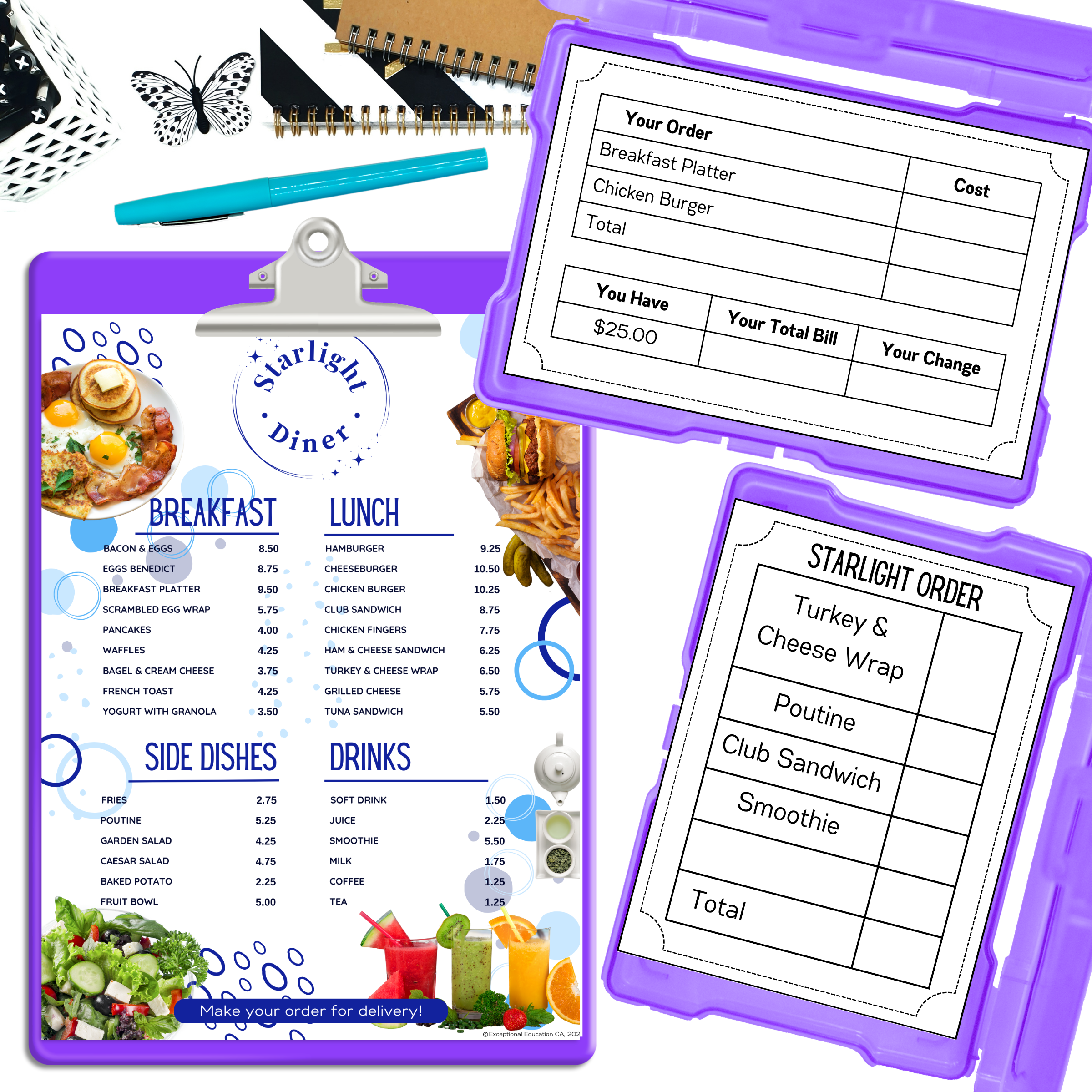
A menu math resource allows you to set up a mock restaurant in your classroom. Students practice ordering off of a menu, calculating their total, and payment as a customer. They also practice the role of server by taking orders, filling orders, calculating a bill, and making change.
Working on Social Skills through Math Instruction
There is also a social skills component that is so important in this kind of classroom simulation. Students practice the various social interactions that happen in both roles in a restaurant - serving and purchasing.
This also works with grocery store resources where students can practice being a cashier. This also includes various money skills, as well as social interactions appropriate to retail sales. As a customer, they will practice the same social interactions from a different perspective, as well as crucial daily money skills they will need and use for the rest of their lives.
3. Teaching Strategies for Different Learning Levels
In special education, every student has a different ability level. This leads to unique and specific IEP goals for each student. Using varied and scaffolded teaching strategies helps students to access information where they currently are, and allows you to have a road map for how to move them forward with each of their IEP goals.
There are so many different teaching strategies that you can use with students. Here are a few ideas:
Visual Supports: Use real money or printed visuals to help students understand coin and bill values. Use reference sheets for students to remember the values of coins and bills. Create a visual strip with a series of steps needed to complete a particular task. This can include images or just words, depending on the student’s reading level. This allows students to reduce the number of verbal prompts needed until they become familiar with a task.
Hands-On Practice: Incorporate play money, grocery ads, and debit/credit cards to allow students to work with the actual items (or as close to them as you can). This allows students to experience shopping and working in a real and relatable way.
Repetition & Routine: Reinforce skills by incorporating money-related activities into daily or weekly lessons. This can include grocery store, dollar store, coffee shop, restaurant, take out restaurant, cooking in the kitchen, and running a tuck shop in the classroom or school. There are so many ways to incorporate money skills into the student’s daily routine. The key is to be clear about which skill you are focusing on and make that the focus of each experience. Remember that there are multiple skills that can be worked on using these types of activities. Money skills, literacy skills, social skills, and following directions to name a few.
4. Encouraging Independence
Beyond classroom activities, it’s important to help students build independence with money management:
Teach students to read receipts and compare prices. They should also be able to have a general idea of how much their bill should be. For example, if they went to the dollar store to purchase a few items and their bill is several hundred dollars, they should be able to recognize that something isn’t right. They should read receipts after their purchase to be sure they were not overcharged. It is also good practice for students to make an estimate of how much they think their bill will be before they go to the cash register, so that they are better able to determine if there has been an error before spending their money.
Discuss the importance of making smart spending choices and sticking to a budget. Activities that allow students to determine how much they can buy when given a certain amount help them to take an abstract concept and make it a little more tangible. There are also some really good resources that help students determine if they have enough for their bill.
Relate money skills to future job opportunities and independent living situations. One of the ways I love to do this is by starting the week with a recipe plan. We then go through the recipe, determine what ingredients we need, make a shopping list, shop for the items using a budget, and then make the recipe toward the end of the week. This can then be extended to creating a weekly meal plan, shopping list, etc. This helps students to learn the routine of planning and shopping for meals in the home.
Putting it all together
Mastering money skills empowers students to navigate daily life with confidence. There are many aspects of independent living that rely on experience with various money skills. By combining real-world practice, structured resources, and engaging activities, we can help students build independence in their lives outside of school through essential financial literacy skills.
If you are interested in more tips and resources for your Special Education Classroom, be sure to check back on the blog for more upcoming articles. You can also join my free community of Secondary Special Education teachers for a supportive and welcoming space to ask questions and chat with other teachers.
I would love for you to reach out with what you are doing in your classroom that is working well for you. Send me an email at [email protected] and let's chat!